How I run a one-person media operation on n8n
How a dozen n8n workflows watch the marketing-AI press, dedupe into one Notion database, post to X and Bluesky, and alert Slack when a run fails.
Keeping up with marketing AI is a full-time reading job before you write a word, so I automated the reading. A set of n8n workflows watches the sources I'd otherwise check by hand, files everything into one Notion database, and turns the items I keep into social posts that I approve and publish. Below is what each workflow does and how they hand off to each other.
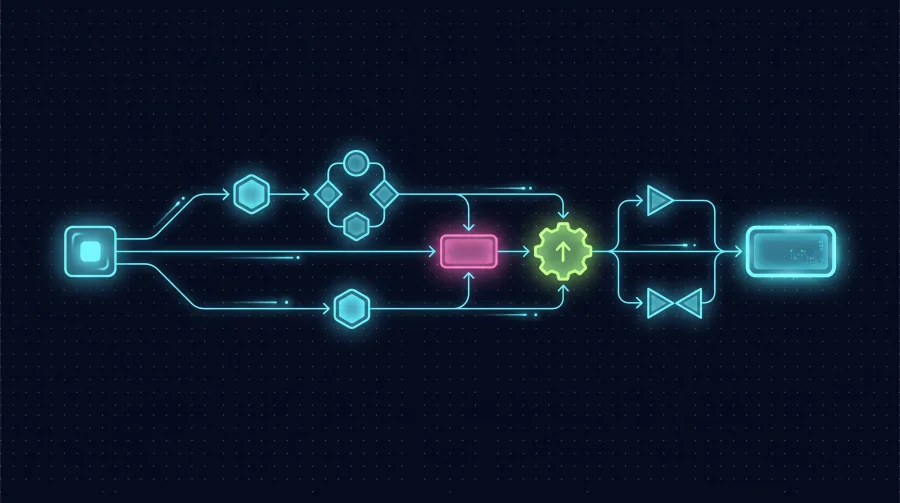
How the workflows connect
Every workflow does one of three jobs, and they connect through two shared points.
- Intake: a dozen monitors, each watching a different kind of source on a schedule and writing to the same Notion database.
- The Notion "intake" database: every monitor dedupes by URL and creates a normalized Notion page with title, source, URL, date, and a snippet. That database is the single source of truth, and nothing downstream needs to know which monitor found an item.
- Publish: I review the Notion queue, a draft gets written, and a single webhook fans it out to the social accounts.
- One error handler: every workflow reports failures to the same Slack alert, so a broken feed pings me instead of failing silently.
Intake and publishing never call each other directly; both read from and write to Notion. That's why I can add a new source or a new social channel without touching anything else.
The intake monitors
Each monitor runs on its own schedule, pulls from its sources, merges, dedupes by URL, normalizes the fields, and writes to the Notion intake database. They share that sequence and differ only in source type.
- RSS Intake — the industry trade press and AI outlets: AdExchanger, IAB and IAB Tech Lab, Digiday, Marketing Dive, IAPP, the Marketing AI Institute, MIT Technology Review, TechCrunch, VentureBeat, Wired, and TLDR AI. Runs every 12 hours.
- News & Web Articles Monitor — broader web and news coverage beyond the fixed RSS set.
- Reddit RSS Intake and Reddit AI Subreddits Monitor (plus a monthly top variant) — the AI and marketing subreddits, for what practitioners are arguing about.
- Substack Newsletters Monitor — the independent writers who break things before the trades do.
- Podcast RSS + Vimeo Intake — audio and video, so talks and interviews land in the same queue as text.
- X Thought Leader Monitor and LinkedIn Profile Monitor — a short list of specific people on each platform.
- Web Capture Webhook — a manual catch-all: send any URL to the pipeline from a browser and it lands in the same database.
Review and publish
- Publish Social — a webhook that takes a normalized payload and fans it out with a per-channel on/off switch: X, Bluesky, and Threads (wired but off). Each channel posts independently and the results merge back into one response, so one failed channel doesn't sink the others.
I do the step between intake and publishing myself. I read the Notion queue, decide what's worth saying something about, and approve the draft before the publish webhook fires.
The safety net
- Content Pipeline Error Handler — Slack Alert: set as the error workflow across the pipeline. When any workflow throws, it posts the workflow name and error to Slack. A dozen scheduled jobs pull from flaky external feeds, and without this alert a dead feed would go unnoticed until I wondered why the queue was quiet.
Take the workflows
The sanitized templates live in the n8n-workflows repo, with credentials and personal sources stripped out. Two are written up on their own here:
To build something similar, start with the Notion database and one intake monitor, get that writing cleanly, then add sources one at a time. The pipeline pays off only once the reading takes more of your week than building and maintaining the workflows would.